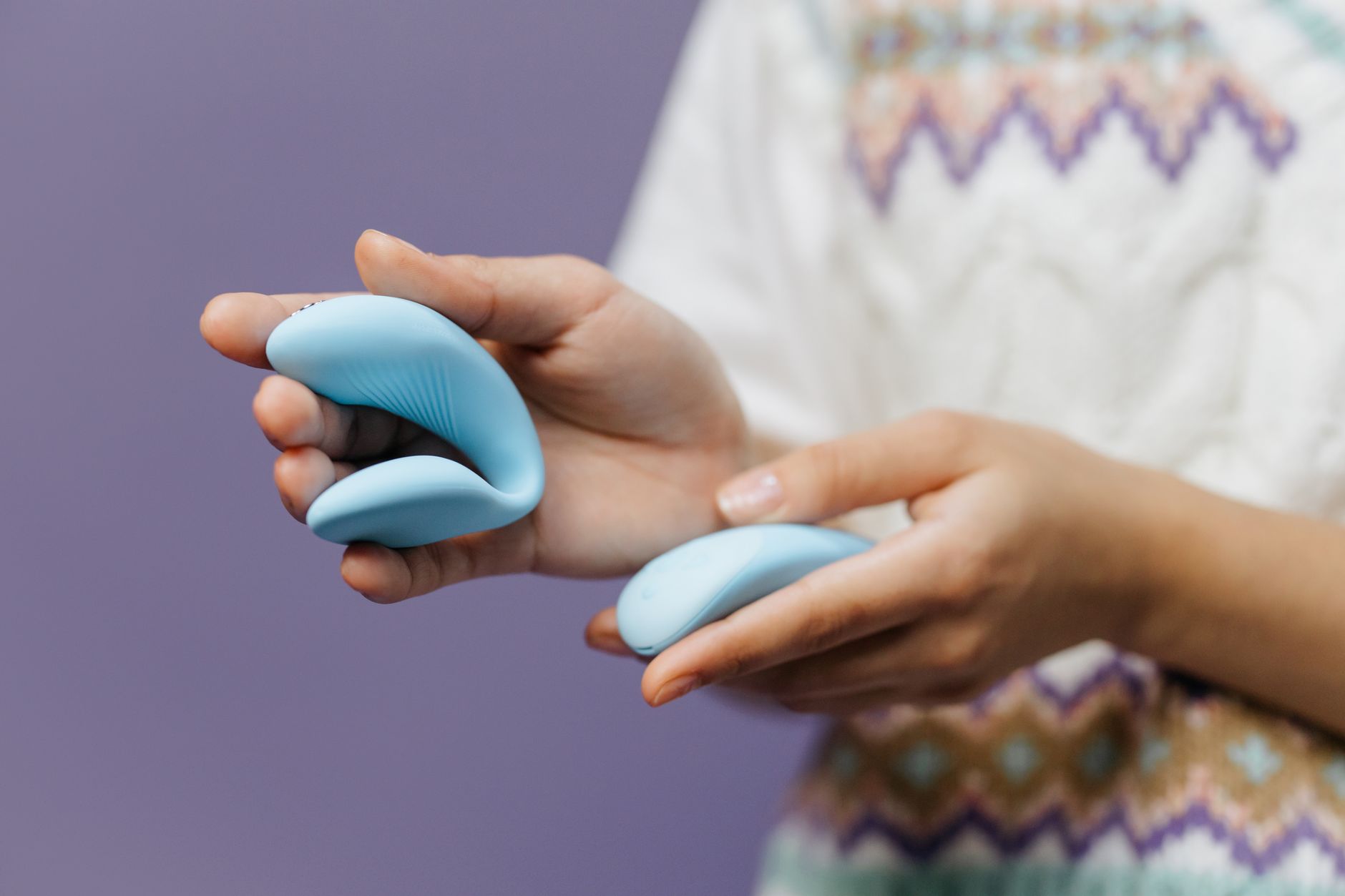
How to Use Lemon Vibrators When You Feel Disconnected From Your Body
Dissociation during sex doesn't mean you're broken. It means your nervous system needs a different kind of attention. Here's how lemon vibrators become a grounding tool.
You're with your partner. Everything is supposed to feel good. But somewhere between kissing and touch, you float away. Your body is there but you're not quite in it. You might hear what's happening around you, or feel pressure without sensation, or suddenly become hyperaware of the mechanics instead of the pleasure. It's like watching yourself from above, or experiencing sex through a thick pane of glass.
That's dissociation. It's your nervous system's way of protecting you when it senses threat, stress, or overwhelm. And it's way more common than anyone talks about.
Dissociation during sex isn't always rooted in trauma. Sometimes it arrives from everyday stress. A brutal week at work. Relationship tension that never got resolved. Anxiety about how you look. Overthinking whether you're taking too long. The mental load of caregiving. Financial worry. Political rage scrolling at midnight.
Your body reads all of that as a threat signal. Even if the sex itself is fine, even if your partner is attentive, your nervous system says: we need to leave. And so it does.
Other times, disconnection is genuinely trauma-related. Past assault. Coercive relationships. Medical abuse. Your nervous system learned long ago that being fully present in your body during sex meant danger. That survival strategy protected you then. It's just still running now.
The good news: lemon vibrators give your nervous system a reason to come back.
The clitoris has roughly 8,000 nerve endings concentrated in a space the size of a pea. When you use a lemon vibrator at the right intensity, you're flooding your sensory system with specific, localized input that's hard to ignore.
Unlike partnered sex, which involves multiple simultaneous sensations and the cognitive load of relating, a lemon clitoral vibrator creates a single point of focus. Your brain can't wander as easily. The specificity of sensation actually quiets the part of your mind that's trying to leave.
That's not a metaphor. Your vagus nerve, which manages your nervous system's safety signals, responds to rhythmic, predictable stimulation. When you control the vibrator, control the pattern, control the intensity, you're telling your body: this is safe. I'm in charge.
Start with the environment, not the vibrator. Dim lighting. No phone. No screens after. Temperature comfortable. Blankets nearby. Your brain needs to know it's safe before your nervous system will let your body relax into sensation.
Next, use your five senses intentionally before you start:
See. Look at your vulva. Not in a performance way, in a curiosity way. You're checking in, not checking yourself out.
Listen. Notice what sounds are around you. Silence, a fan, music. Anchor to it.
Touch. Put your hands on your thighs, your breasts, your stomach. Feel the skin. You're mapping your body as something that's yours.
Smell. Light a candle if it helps. Something grounding. Vanilla. Citrus. Nothing too complex.
Taste. A sip of water. Just present with it.
Now pick up your lemon vibrator. Start it on the lowest setting. The goal isn't orgasm. The goal is sensation. Slow, predictable movement. Notice what you actually feel without judgment. Tingling, warmth, pressure, relief.
If your mind starts to float, pause. Touch the vibrator to a different spot. Feel the difference. Name what you're noticing. Cold. Smooth. Circular motion.
This is grounding work. It's meditation with pleasure as a side effect, not the main event.
Set a timer for 15 minutes. Just sensation exploration. No pressure to come. That actually makes it easier for your nervous system to relax because the stakes disappear.
Many people find that after a few sessions of slow, intentional use, their body starts to recognize safety again. The dissociation loosens because your nervous system realizes: I was present during that, and I'm still okay.
It's repetition-based learning. Your body rewires itself through consistent experiences of safety.
If you have a partner, they don't need to be in the room for every solo session. In fact, most people reconnect faster alone first.
Once you're able to reach the clitoris with a lemon vibrator and stay present for 10-15 minutes without drifting, that's when you might try with your partner nearby. Not engaged. Just present. Reading. Quiet company.
The next stage: they watch while you use the vibrator. No touch from them. Just witnessing.
Then, they use it on you while you give feedback. Start, stop, different intensity. You're in control of the input.
This is how you rebuild trust in your body during partnered sex. You reintroduce another person slowly, while maintaining the safety signal of the vibrator.
This matters because the treatment is completely different. If you're not interested in sex, that's a conversation with yourself and maybe a healthcare provider. If you're interested but your body won't cooperate with being present, that's a nervous system recalibration problem.
Lemon vibrators help with the second one specifically. They help you reconnect. They don't manufacture desire if the desire isn't there. So notice the difference before you start.
Week one: you use a lemon clitoral vibrator alone, very low intensity, for ten minutes. You drift a few times. You pause and refocus. That's normal.
Week two: you can feel the difference between two intensity levels. You're anchored to sensation for longer stretches.
Week three: you notice your mind isn't leaving as much. You're present for part of the time and that feels like progress because it is.
Month two: dissociation still sometimes shows up, but you have a tool to navigate it. You know what to do.
This isn't linear. Stress will pull you back into dissociation. That's not failure. That's your nervous system doing its job. The skill is knowing how to return.
If dissociation during sex is tied to trauma, a sex therapist trained in trauma can help. The Lemon Suckers community is great, but a trained professional can offer something different.
If dissociation is severe (you lose time, you don't remember what happened), talk to a therapist before focusing on reconnection work.
If it's mild and situational (stressful week equals floating), the grounding protocol above often helps on its own.
Your nervous system will tell you what it needs if you listen.
Partner presence adds variables your nervous system has to manage: another person's energy, unpredictability, relational dynamics. Solo play is predictable because you're controlling every element. Your nervous system relaxes. If dissociation happens solo too, that signals deeper nervous system dysregulation and is worth talking to a professional about.
Not instantly, but yes, over time. Your nervous system learns through repetition. When you repeatedly pair clitoral sensation with safety (you're in control, you can pause anytime, there's no pressure), your body learns that being present during pleasure is actually safe. That's neuroplasticity in action.
That's completely normal. Nervous system work isn't linear. Your body might get comfortable for five minutes and then a weird sound happens and the threat response kicks back in. Pause, reorient, ground again. This is the actual work of reconnection.
No. Not being in the mood is lack of desire. Dissociation is desire being present but your body refusing to let you experience it. You can want sex and simultaneously not be in your body during it. They're different problems with different solutions.
If they're going to be involved eventually, yes. But you don't have to tell them everything. "I'm working on being more present during sex and I want to take some time to explore that alone first" is enough. The details are yours to share or not.
Then the vibrator is doing its job by showing you that disconnection is deeper than situational stress. That's information. It might be time to work with a trauma-informed therapist. Lemon vibrators are tools for reconnection, but they're not a substitute for professional support when the disconnection runs deep.